
How much electricity does an AI tool actually use? We did the maths on Fundsorter.
Last week, the United Nations University Institute for Water, Environment and Health published a landmark report — Environmental Cost of AI's Energy Use: Carbon, Water and Land Footprints. It's one of the most detailed public assessments of AI's environmental footprint to date, and the headline numbers are BIG.
In 2025, data centres consumed an estimated 448 TWh of electricity globally. If data centres were a country, they'd rank 11th in the world for electricity use. AI workloads made up about 20% of that, and on current trajectories AI could push data centre demand toward 945 TWh by 2030 — enough to power every home in Sub-Saharan Africa for more than five years.
That's the global picture. But we wanted to bring it down to ground level: what does AI actually cost, in electricity terms, for one charity using Fundsorter? So we used the new UN data (alongside Epoch AI and EPRI's recent work) to refresh our own environmental impact methodology. Here's the headline.
Fundsorter customers use 18 kWh per organisation, per year.
Pulling two recent months of token usage from our AI provider, weighting it by model class (smaller models use less energy than larger ones), and dividing by our active customer base, our central estimate is ~18 kWh per active customer organisation, per year.
What does 18 kWh actually feel like? Here's what that looks like in everyday terms:
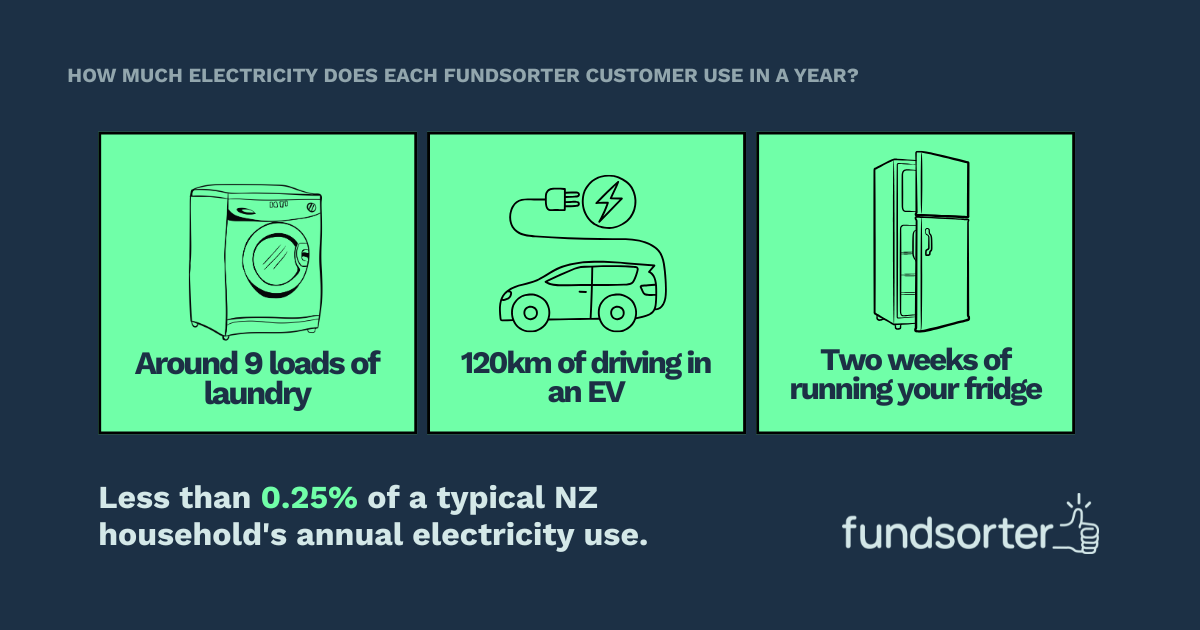
18 kWh is about the same as 9 loads of laundry in a standard washing machine, driving 120 km in an EV (Auckland to Hamilton, one way, 75 days of a 10-watt LED bulb running 24/7, or running your kitchen fridge for about two weeks. It is less than a quarter of one percent of a typical New Zealand household's annual electricity use.
For comparison, the UN report estimates a single ChatGPT-style text query at around 0.42 Wh. A complex AI-generated video can draw 415 Wh — enough to run a normal lightbulb for 42 hours. Fundsorter's work is text-only matching and drafting, which sits at the lighter end of the spectrum.
This estimate covers AI inference electricity only. It doesn't include training the underlying models, our hosting infrastructure, or the embodied energy in the hardware. The UN report rightly emphasises that electricity is just one dimension - carbon, water, and land footprints all depend on where a data centre sits, how it's cooled, and what powers it. Usage isn't evenly distributed either. A charity running lots of scans will use more; a light-touch user will use less.
So why publish this? Because we reckon charities deserve to know. AI helps the sector find funding it wouldn't otherwise reach AND it has a real, measurable environmental cost. Transparency is important to us, and so is our environment - we’ll keep you updated as data, and our own systems and processes, improve.
The UN report is at unu.edu/inweh.