
What Australia has worked out about AI that we haven't
Reflections from Philanthropy Australia's 2026 conference in Brisbane
We spent three days in Brisbane this month at Philanthropy Australia's 2026 conference. We went to learn, compare notes, and bring home what's useful.
Australia and Aotearoa have plenty in common: a community sector under the same pressures, a disparate philanthropic sector and anxieties about AI. But on some of the biggest questions facing us right now, we're not in the same place at all. It feels like Australia has clocked something collectively that we're only starting to reckon with: the regulatory requirements of technology.
It was clear at the conference that Australia has recognised the public health crisis of social media, and acknowledged that we all stood by and watched it happen without acting. They’ve also recognised that governments and communities have agency - we don’t have to let tech companies dictate terms. They tried the (unsuccessful) under 16’s social media ban and, recognising that it was the wrong lever (treating the symptoms not the cause), have now put out the digital duty of care policy for consultation. This legislation would force companies to let people opt out of algorithmic feeds. Alongside that, Australia has stood up an AI Safety Institute, to evaluate tools and their impacts.
While implementation details of many policies remain to be settled, at the conference, we heard a clear consensus that there is regulatory responsibility in regard to big tech. And a consensus that as a society, we have to understand the lessons from failing to regulate social media and apply them to AI, a change which is coming even bigger and faster.
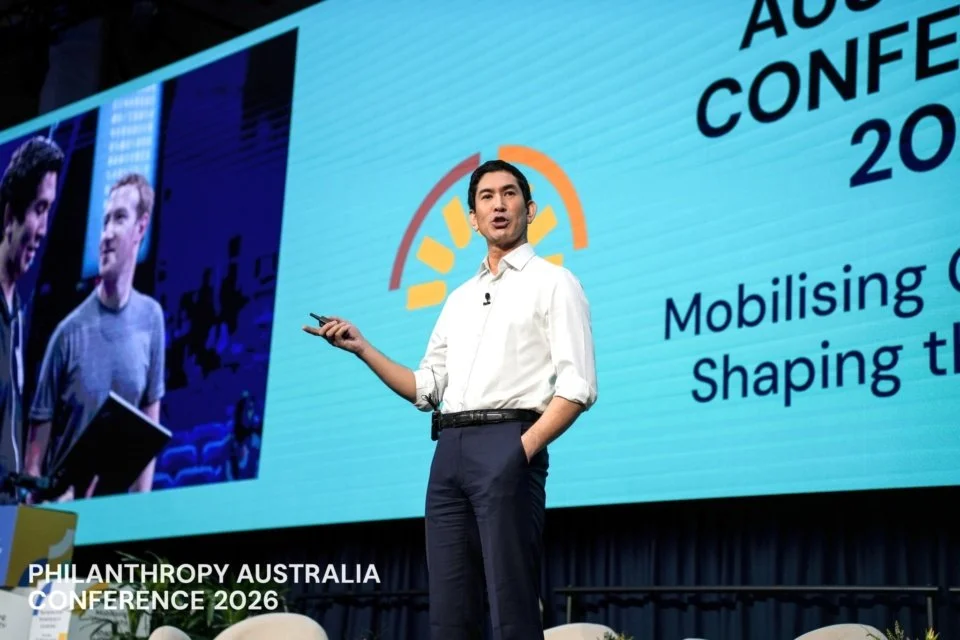
Dex Hunter-Torricke, Founder & President at Center for Tomorrow, speaking at the Philanthropy Australia Conference - picture by Philanthropy Australia
We're doing none of this. New Zealand's AI strategy, released last year, is deliberately "light touch" — no new AI-specific law, just the handy-wavy idea that existing privacy and consumer protection rules will cover it. We're not having the same structured, public conversations about safety, ownership and responsibility.
At the same time, we heard optimism toward tech that we’re sometimes lacking in Aotearoa. For example, the idea that green data centres, running on renewable energy, could be a massive economic opportunity. Until now, Australia hasn’t had a way to plug its sunshine into the global power grid, but selling compute could make renewable power an export commodity for the first time. Countries with green infrastructure potential and trustworthy governance could have a real edge, especially given growing awareness of data sovereignty and data centre environmental impacts. When we heard that we thought, hey wait, Aotearoa is a country like that!
Of course, there are many considerations about data centres beyond just power generation (water use, noise pollution, e-waste). And the biggest question is probably ownership: it’s not a boon to a local economy to host a data centre if all its profits go straight offshore. But the point is, we’d like to see this kind of aspirational thinking in New Zealand. What could regenerative, positive possibilities out of this new tech be for our country? What would it look like if we regulated it well, and leaned into our integrity as a strength?
We left the conference with the sense that, as well as the policy landscape, the tenor for the conversation is different. So much AI discourse sits at one of two poles: "AI is amazing" on one side, "AI is going to kill us all" on the other. Neither is a useful place to make decisions from.
The best sessions in Brisbane sat in the middle: how do we regulate these tools so they work for us? There were panels on who's coding the future, and on philanthropy's role in shaping AI rather than just reacting to it. We want more of those conversations here at home.
We came home with more questions than we arrived with, which is usually the sign of a conference worth going to. Ngā mihi nui to Philanthropy Australia for having us, and to everyone who gave us their time in Brisbane.
Lani Evans and Alanna Irving