
Planting, not policy
What the data says about climate and nature funding in Aotearoa
Yesterday I was part of a panel hosted by the Funders' Commitment for Climate Action Aotearoa — Climate and Nature-Positive Philanthropy: Where funding is flowing, what's working and what's missing — alongside Esther Whitehead (FCCA), Pip Wheaton (The Climatics), Izzy Fenwick (Climate Foundation), Rebekah Hasloch (FCCA) and Arohanui West (Te Rūnanga o Ngāti Kearoa Ngāti Tuarā). I was, by a comfortable margin, the least knowledgeable person on that panel when it comes to climate change. What I do have a good grasp of is what's being prioritised by funds across the motu, and a growing understanding of where funding actually flows.
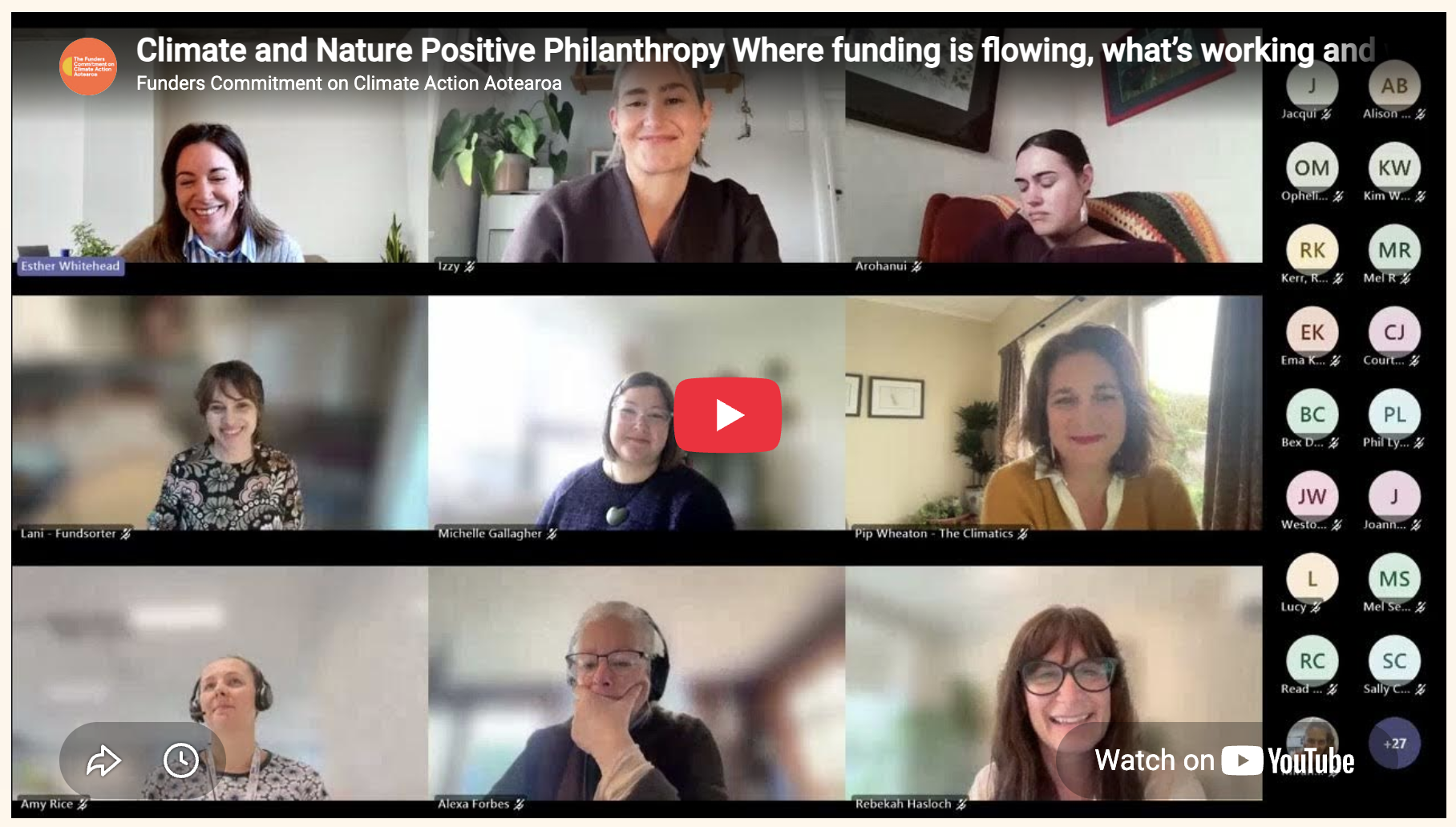
Climate and Nature Positive Philanthropy panel.
At Fundsorter we maintain the structured database of funding opportunities open to New Zealand community organisations - just under 4,000 opportunities, all vetted, coded and tagged. We use it to help community organisations find grant funding, and we use it to generate insights about the funding system itself. To prepare for the panel, we reviewed 524 funding opportunities in our system that name the environment. This is what stood out.
The environment is one of the most-named causes in the country
Our taxonomy splits environmental funding three ways: climate change, biodiversity and conservation, and waste minimisation. Together they make up 20% of all live funding opportunities in our system — 524 out of 2,595. That's the biggest named cause grouping in the database. This isn't a visibility problem: everyone names it.
But most of the domestic money is small, and short-term
Nearly half of domestic environmental grants cap at $10,000 or less. Of the domestic opportunities that tell us their maximum, only 31 out of 524 go above $50,000. So it's a lot of very small grants — and organisations are forced to jigsaw-puzzle funding together for anything substantive.
It's also very much short-term money. This work needs a long-term fix, but the funding runs on financial years. Only 14% of opportunities offer multi-year funding. 25% of funding opportunities explicitly exclude operational costs, and only 11% allow them. Which makes it very hard to hold onto staff, or to move beyond grassroots and volunteer-led.
That lines up with Dr Marie Doole's 2024 report Empowering Action, which surveyed over 300 community conservation groups and found funding skewed toward materials — traps, plants, tools — rather than staff time or monitoring and evaluation. She also found more than 60% of groups were self-funding to stay afloat, with volunteers and staff covering basic costs.
The international picture is better
We have 131 international environmental opportunities live — more than any other cause area we track. And climate is the international story: 35% of our climate opportunities are international, by far the highest share of the three categories. International grants are also much larger — nearly half are over $50,000.
Planting, not policy
In New Zealand, 5% of environmental funding will pay for advocacy. Internationally, it's 32%. The reasons for that are varied. Some of it is theory of change — a genuine belief about where the leverage sits. Some of it is funder constraints, which can be founder-driven or legislative. And some of it is a perception problem that fails to distinguish between politics and advocacy.
Councils are the biggest domestic funder in this space
Councils distribute over half of all domestic environmental funding opportunities — and what they fund is specific.
City and district councils skew heavily toward waste minimisation (42%). For regional councils, 61% is biodiversity and conservation, and a particular kind of it: fencing and planting waterways, pest control, erosion and sediment work. Not species recovery or marine, which councils barely touch.
Councils also have the lowest barriers to entry. You don't need to be a registered entity for most council funds, which opens the door to a lot more grassroots mahi.
That's what funders say. Here's what they did.
We don't yet have nationwide data on where funding actually goes, but we do have it for Canterbury and the Waikato. I'm using those as an indication, not a national picture — but what's striking is how similar they are.
Environmental funding overall isn't underfunded. In the Waikato, the three categories together take 6.6% of dollars — second only to sport. What's underfunded is climate. Climate receives about 1% of total funding in both regions. Biodiversity does several times better. And Class Four gaming trusts — a quarter to a third of all funding in each region — give almost nothing to climate.
There are some almost-empty niches. Climate emergency preparedness has one dedicated fund in the country. Low-carbon transport has two. Urban greening, reuse and repair, product stewardship, and carbon sequestration have three each.
What would help
If you're funding into this space: fund multi-year where you can, and fund operational costs. Those two shifts would do more for the sector's capacity than almost anything else on this list.
And on our side — we're working with regional funders to collect and publish data on where funding actually goes in their region. If you'd like to support one, come and talk to me. Once we have that picture for all of Aotearoa, we'll be far better able to pinpoint the gaps, and to fill them.
Ngā mihi to Esther, Rebekah and the team at Funders' Commitment for Climate Action Aotearoa for having me, and to my fellow panellists.
If you're a community organisation looking for environmental funding, there are 524 live opportunities in Fundsorter right now. Try it for free, or book a demo to see what it finds for you.