
Digital & Innovation Grants for NZ Projects
Startup funding may make you think equity investment. But grants are also available to New Zealand projects, if you know where to look.
We analysed 202 grant opportunities for digital & innovation funding that kiwi organisations can apply to — 8.6% of all the active opportunities in Fundsorter's extensive grants database. This category covers technological and social innovation, including tech for good, digital inclusion and rights, beneficial AI, open-source software, cybersecurity, data sovereignty, and new approaches to social problems. Here’s what we found.
The landscape at a glance
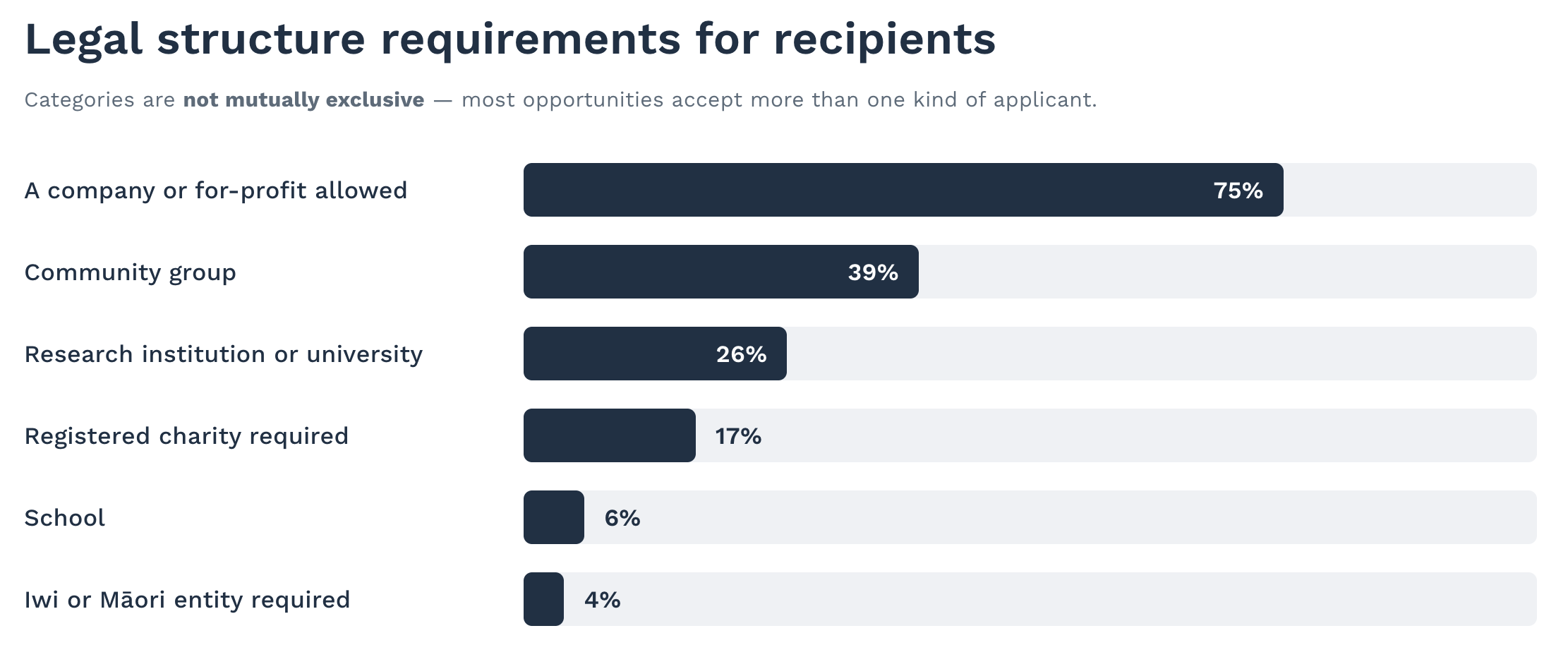
Startups and social enterprises can often also apply for grants: about 75% of these programmes do not exclude companies, while about 25% do explicitly require nonprofit or charitable status. About 85% of the grants in the digital & innovation category involve technology, while 15% focus on social or other innovation without a technology component. Across the board, multi-year and operational funding is rare, and most opportunities are for single year project grants.
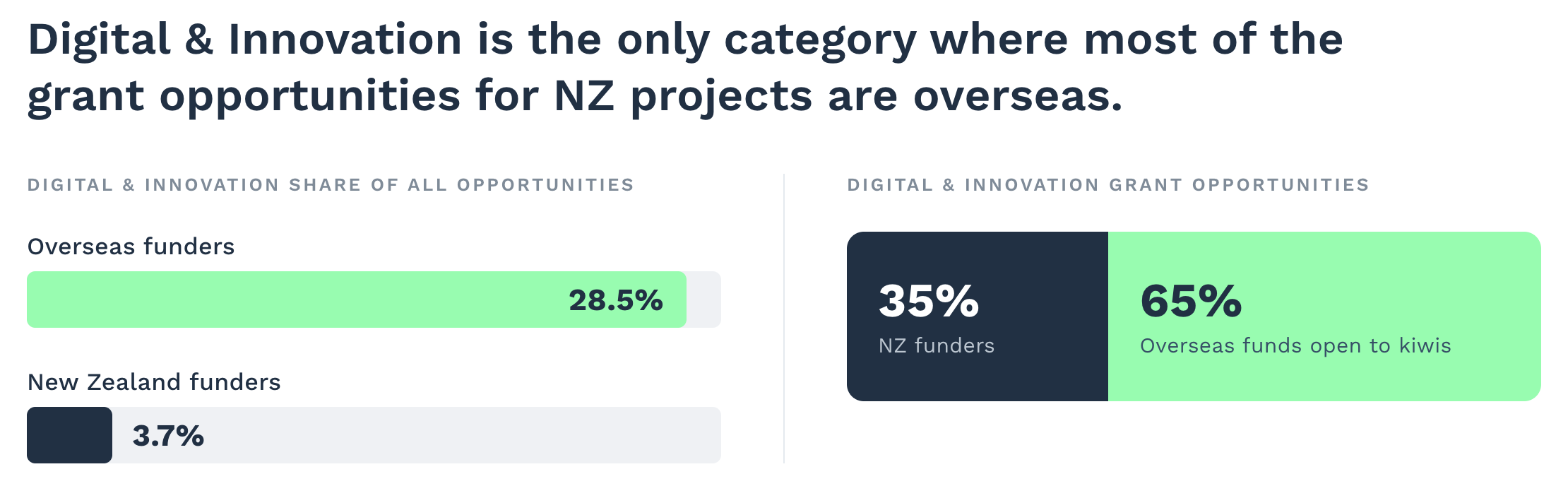
Digital & Innovation is the only funding category where a majority of the opportunities are international — there are nearly twice as many overseas grants available as local ones. Local funding leans towards digital inclusion, climate and clean technology, and primary-sector applications. International funding is more likely to name AI, open source, digital rights, cybersecurity and digital public infrastructure. There's a contrast in grant sizes as well, with international grants having 2.5x higher median maximum amounts you can apply for.
Within New Zealand, the landscape is mostly national (70%) rather than regional (30%). Only 9 digital & innovation grants come from councils, which is the reverse of other topics such as environmental funding, where councils distribute a substantial share.
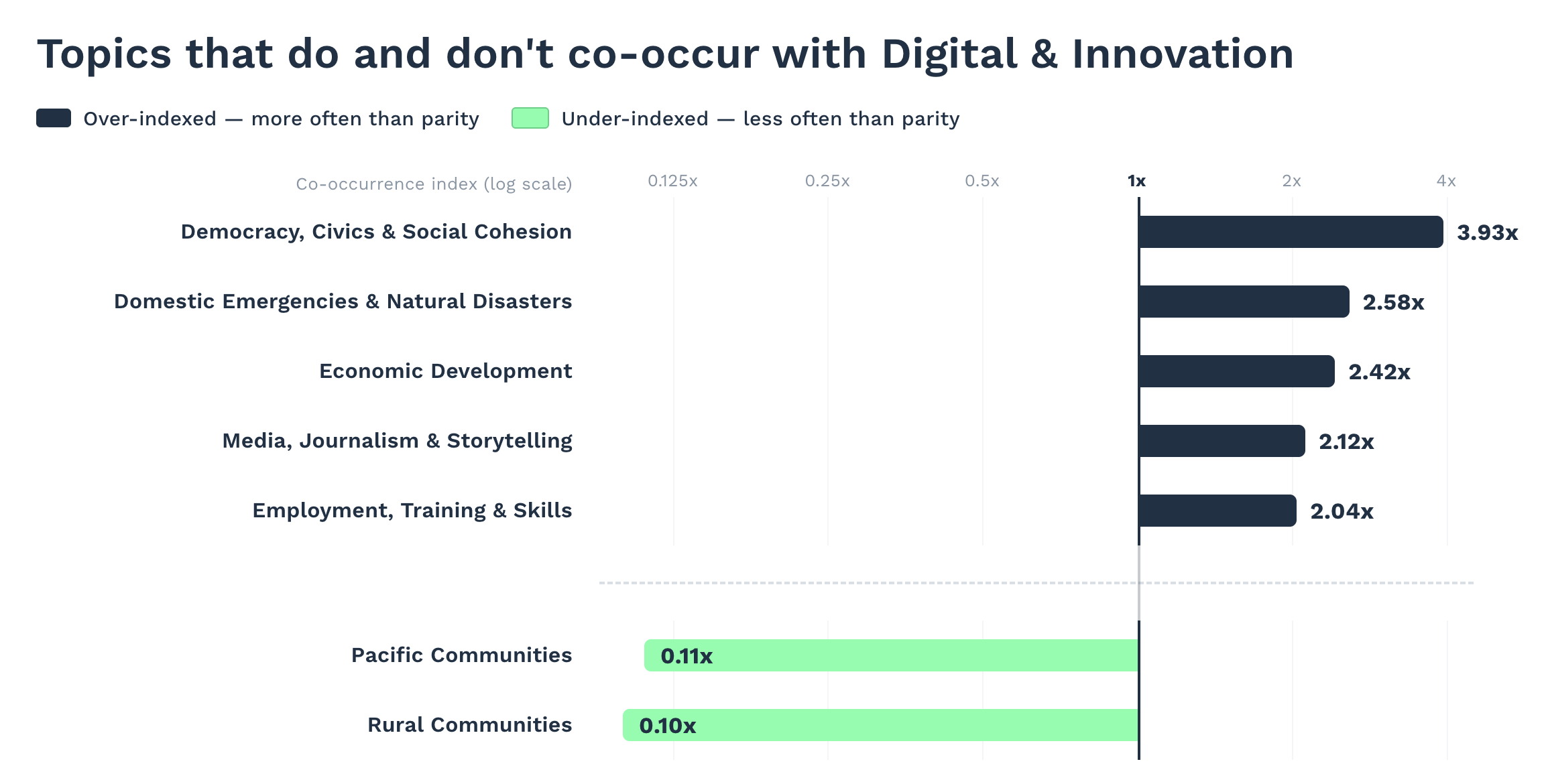
Digital & Innovation funding co-occurs markedly with some topics, and is noticeably under-represented in combination with others. This tells us which causes attract technology money which are being left out of it. The topics over-index (are more likely to co-occur): Democracy & Civics (3.9×), Domestic Emergencies (2.6×), Economic Development (2.4×), Media & Journalism (2.1×), and Employment & Training (2.0×). The most under-represented: Rural Communities (0.10×) and Pacific Communities (0.11×).
About this analysis
Fundsorter maintains a comprehensive database of funding opportunities available to New Zealand organisations. We use this data to match people with suitable grants, and to gain insight into the funding landscape. Our scope is specifically grants for organisations, and does not cover funding for individuals, equity investment, venture capital, debt, or R&D tax credits.
The data consists of funders' stated priorities, not where money ultimately flows (although our research shows what gets named gets funded). There are hundreds more generalist funds that name no priorities, which are not addressed here but might fund digital & innovation projects. The figures here therefore describe the explicitly stated digital & innovation landscape, not the total amount of funding that could support this work.
Digital & Innovation covers several kinds of funding
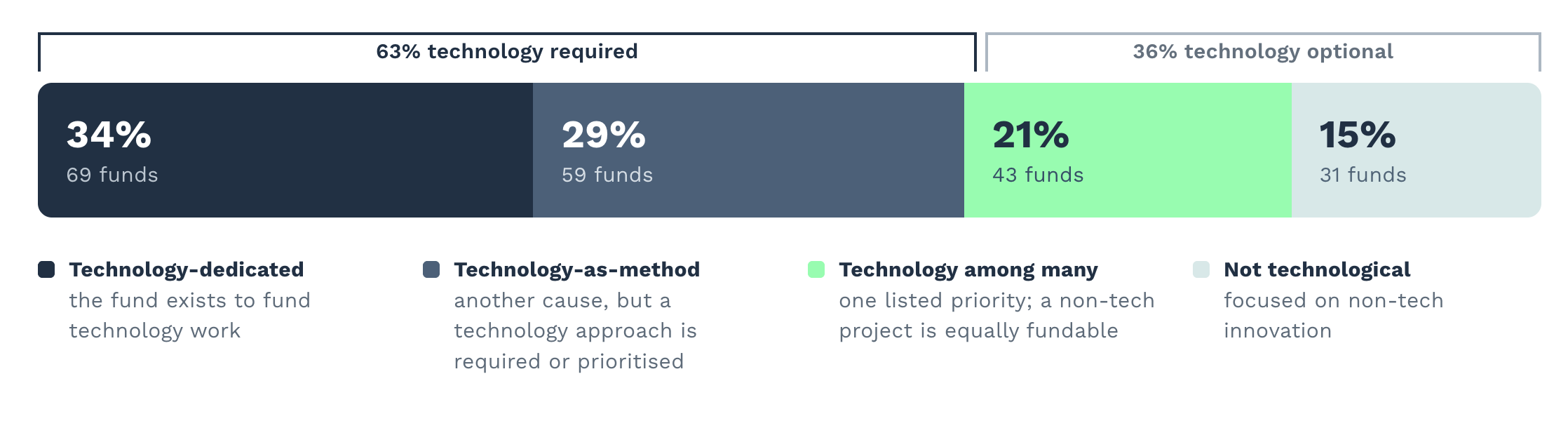
The Digital & Innovation category covers technological and social innovation. That includes digital systems, physical technology, technology applied to another cause, and new approaches or delivery models that may not use technology at all.
In this datsaset, 63% of the opportunities are technology-centred: the fund either exists to support technology work or explicitly requires or prioritises a technology-based approach. Another 21% mention technology as one eligible area among several. The remaining grant programmes support social, community or business innovation.
Most of the funding is for straightforward financial grants (78%). However, we also include competitions where there is a financial prize, grants that come as part of joining an accelerator or similar programme, and grants with in-kind components (e.g. for mentoring, compute, hardware, etc).
Innovation is not a requirement across the full set. About 40% are focused on funding strictly new or untested work, while another 24% give novelty some weight. About 35% aren't novelty-focused and instead support things like events, conference attendance, equipment, core organisational activity and established programmes that relate to digital or innovation subjects.
Comparing local and international grant programmes
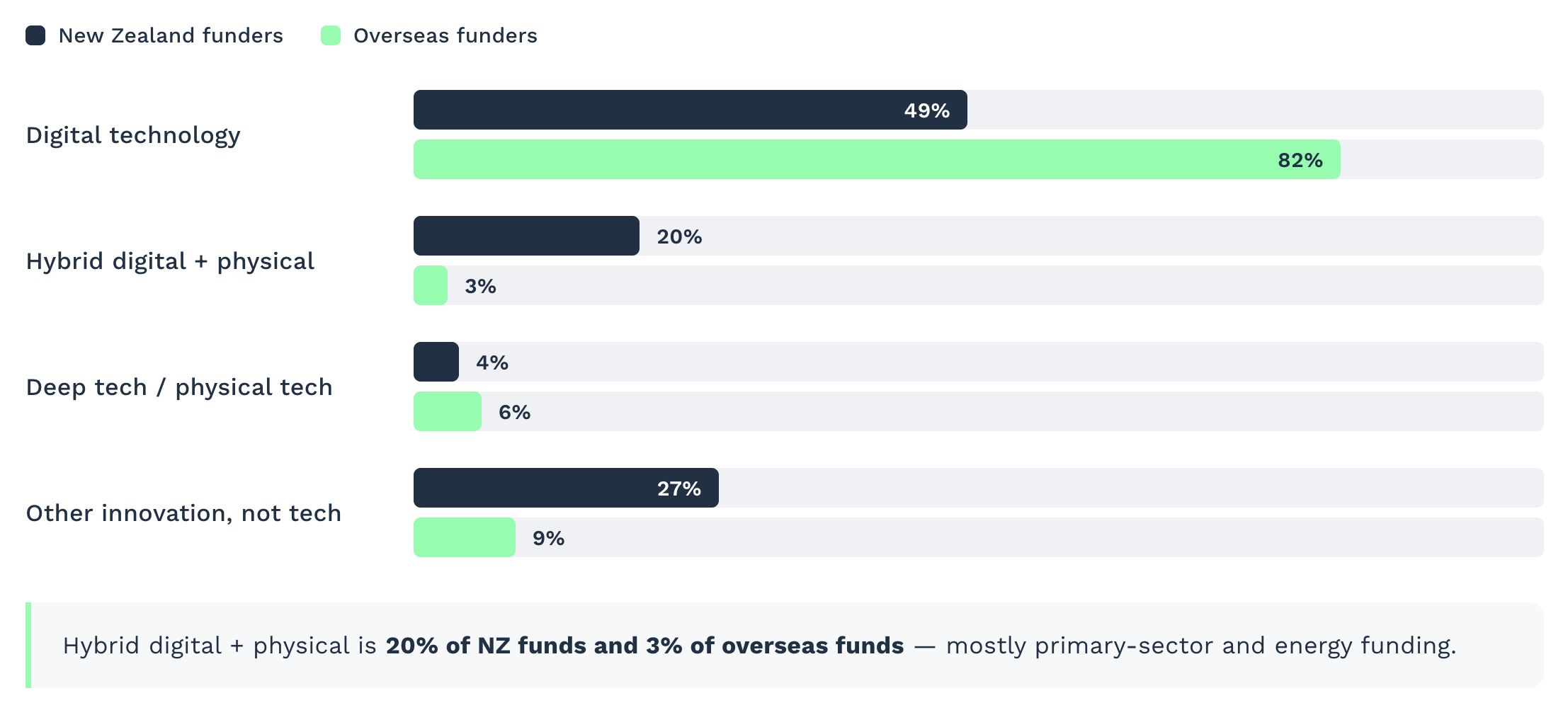
The dataset contains 71 local grant opportunities and 131 international. The international side is not only larger; it is also much more consistently focused on technology. Nearly 80% of all technology-centred grants available to kiwis are international, and overseas funders have a different emphasis.
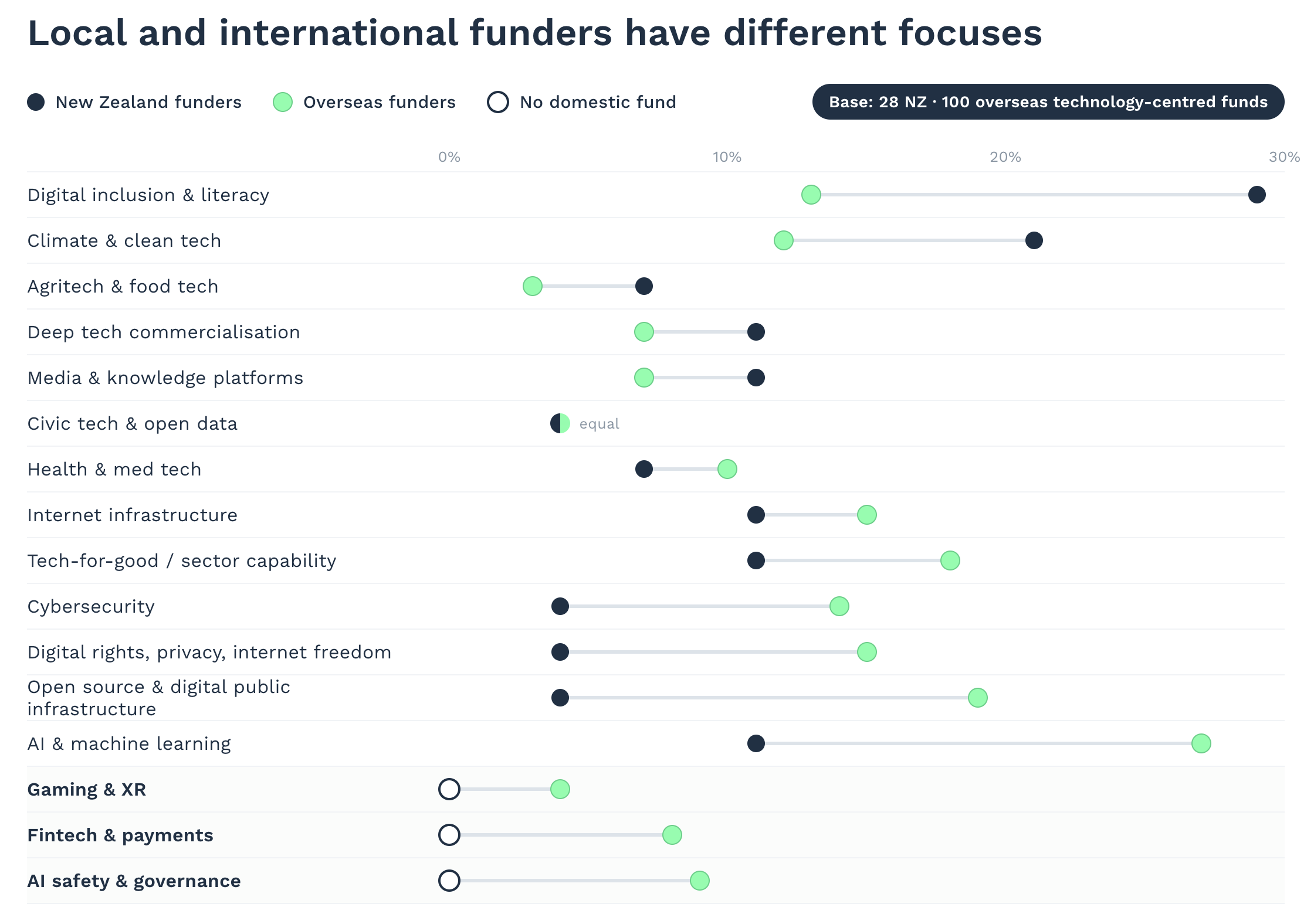
Across the 128 technology-centred opportunities, New Zealand funding most often supports digital inclusion and digital literacy, as well as climate and clean technology. The international set contains more funding for specialised digital fields, like AI and machine learning, open source and digital public infrastructure, digital rights, and cybersecurity. We found no local funding focused on AI safety and governance, fintech and payments, or gaming and extended reality, while kiwis can apply to grants for these from overseas funders.
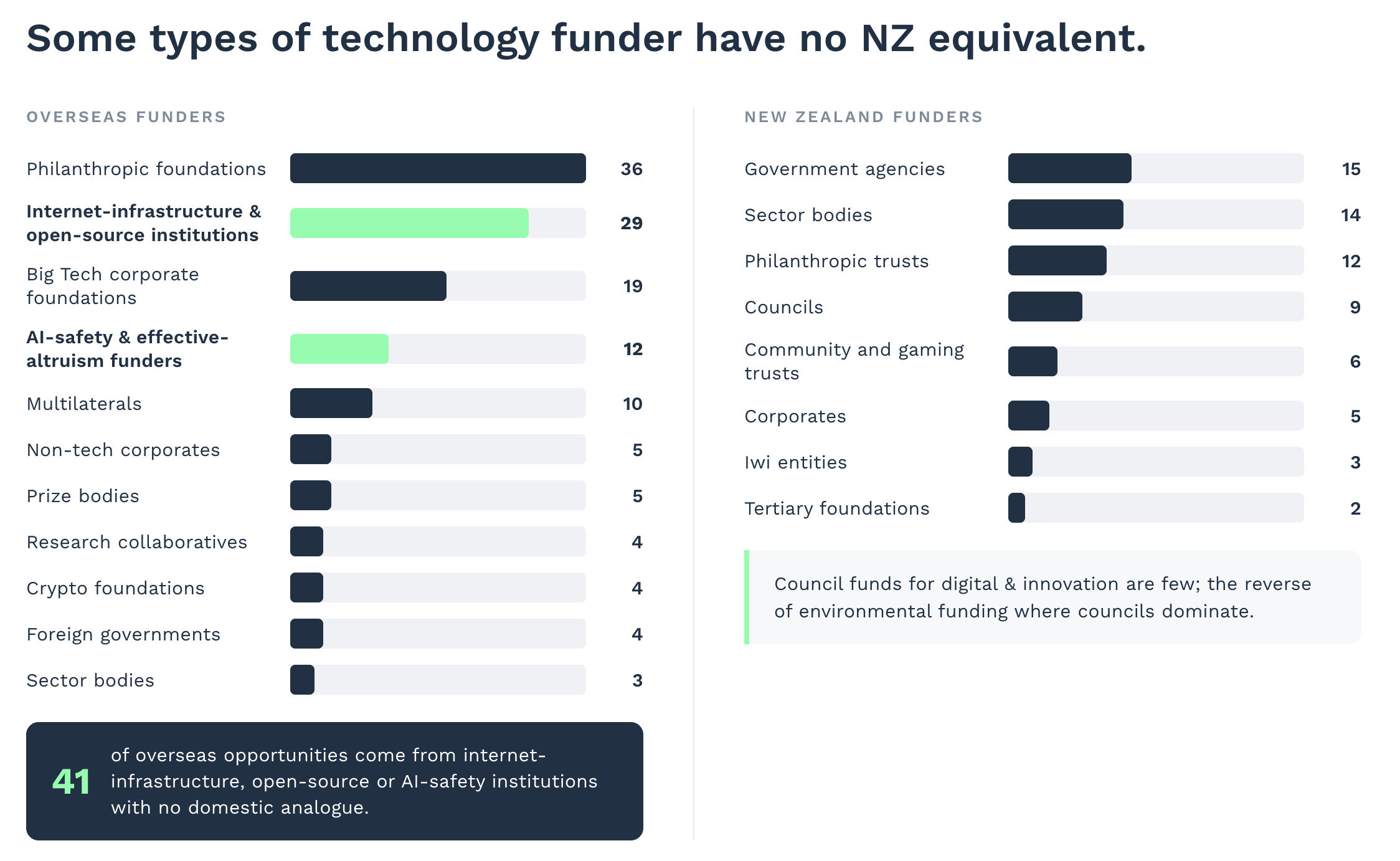
New Zealand opportunities come mainly from government agencies, sector bodies, philanthropic trusts, councils, community trusts and corporate foundations. Internationally, 30% of the opportunities come from internet infrastructure, open-source and AI-safety funders. These institutions have no NZ equivalent in the dataset.
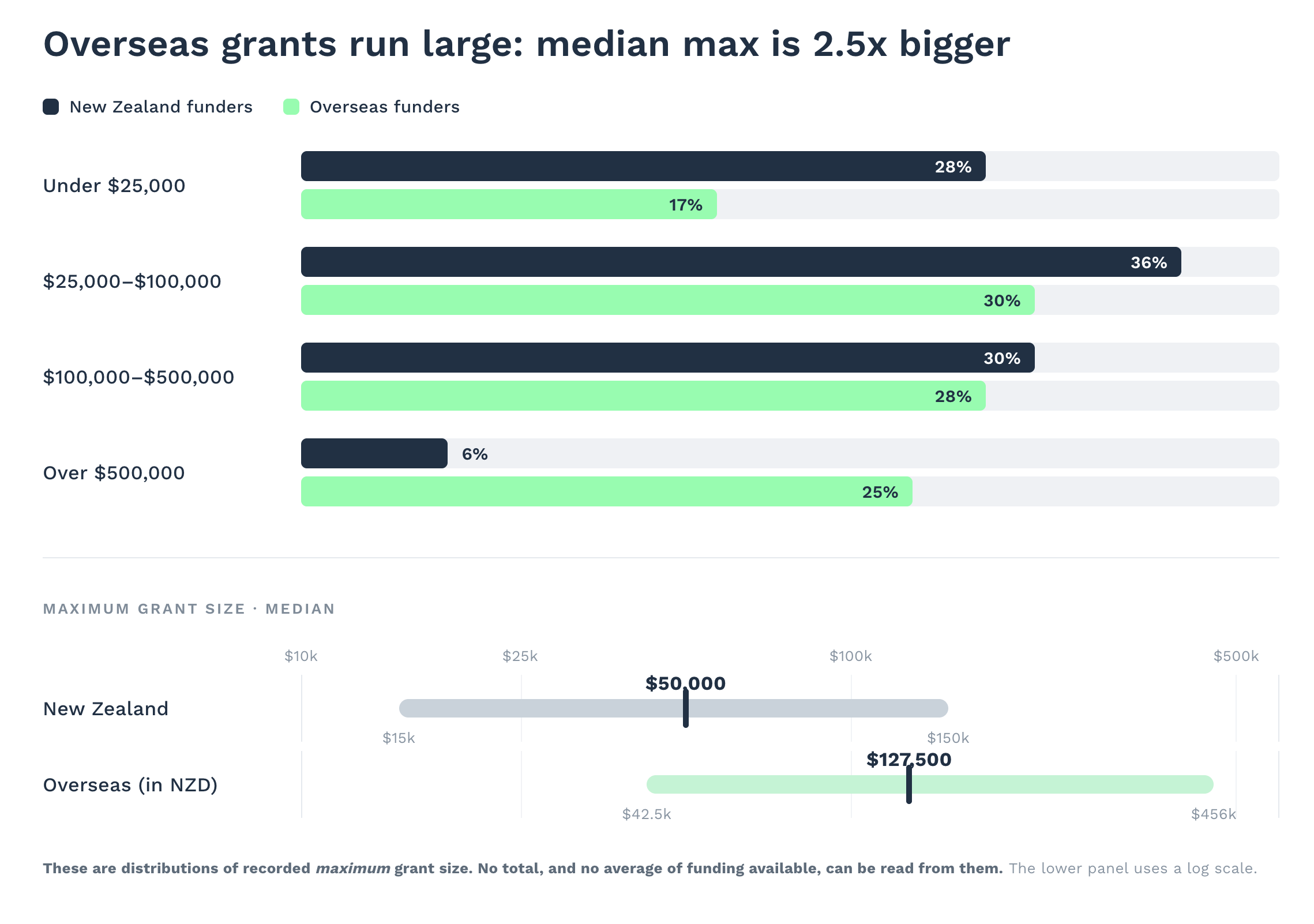
Maximum grant amounts are significantly larger overseas. The median maximum grant size in NZ is $50,000, while overseas that figure is $127,500. More than a quarter of local funding maxes out at $25,000 per grant, while a quarter of overseas grants have maximums over $500,000. These figures are distributions of recorded maximums, not totals or averages of funding available.
Grants are an important part of the picture
Grant funding is only one small part of startup and innovation capital, but New Zealand projects should know that these opportunities are out there, and that international funders are interested in some subjects that we don't have local funding for. Legal structure — whether you're a business or a charity — is often not the main barrier.
The more useful questions are whether a programme supports your kind of work, alignment of intended outcomes, eligibility requirements, and when funding rounds are open for applications. Bringing everything together in Fundsorter can help resolve these questions and narrow down the opportunities that are the best fit — and of course draft applications to take a real shot at the funding.
